Chapter 2: Just… Remember to Smile 🏹
What Brave taught me about the moment leaders choose authority over empathy... and what gets lost when they do.
Welcome to The SHINE Chronicles ✨
A weekly newsletter where I break down stories you already know and love through the lens of The SHINE Cycle™ (See, Hear, Involve, Nurture, Evaluate), my framework for understanding how people and teams develop, stall, and finally move.
[You can read a full breakdown in the free workbook here.]
Each issue, we pull back the curtain on a familiar story and ask: where is this team and what would it take to get them unstuck?
For our second issue, and in honor of Mother's Day, the people have voted. And you guys, this one almost broke me...
It could have been because it was Mother's Day, or maybe because of all the ups and downs of life I've experienced between the last time I watched this film and now, but there was a moment where I actually had to pause the movie and sit with all of the feelings that came up.
They weren't all good feelings either.
Of course I've watched this movie before. Countless times actually. And there's already a lot of deep symbolism for me in the Scottish setting, the bagpipes, the bears. But this time was different. This time I was watching as a mother, as a leader, as a meaning-maker... looking for moments of SHINE.
And boy did I find one.
The Moment That Gave Me Pause
Elinor had just finished helping Merida dress for the presentation of the suitors. In her eyes, everything was exactly as it should be. The dress fits "perfectly". Merida's wild red hair is tamed (as much as it can be). And as she steps back to admire her daughter she sees something she didn't expect.
Merida is struggling against the tightness of the dress and something in Elinor shifts.
We see it in her face as she softens, steps forward, and quietly speaks Merida's name. Not as a Queen addressing a Princess, but as a Mother addressing a Child. And Merida's simple, "Mum?" in reply is almost heartbreaking.
And we can see the door opening, and feel hope enter the room as the possibility of real conversation is so close. After years of missed ones. This could be it.
But Elinor stops herself.
You can actually see it happen in real time. The visible decision, a small shake of her head, and whatever she was about to say is lost in another lesson.
"Just... Remember to smile."
That's where I had to pause the movie.
Because as I watched this scene for the umpteenth time, I didn't witness a mother who couldn't see her daughter, I noticed how she CHOSE not to...
Because she chose authority... over empathy.
And I realized, I have been both Merida and Elinor in different seasons of my life. Which wasn't a pleasant realization.
The Hidden Cost of Authority
I've seen this happen in families as well as workplaces time and time again. A leader, a manager, a head of household catches a glimpse of what someone in their charge is actually carrying... be it pressure, misalignment, or unspoken struggles... and for just a moment begins to lean in. They start to reach out, but almost immediately pull back. Straightening up. Returning to their role.
In these moments it's almost as if the very human act of empathizing with another person becomes a threat to authority. And for so many people, who haven't learned the power of empathy, it does seem that way.
It seems as if empathy gets translated into weakness. Something to be resisted instead of a tool for greater connection. As if listening to someone "below" them will cost their authority rather than deepen it.
Elinor chose to literally shake off the empathetic and motherly response in favor of preserving authority and her idea of what a Queen, and subsequently a Princess, is supposed to be. But instead of just protecting her authority, she compounded the cost of what they both would have to pay in order to fix their bond.
Torn By Pride
To help us understand why that moment matters so much, let's talk about what's actually happening between these two characters across the film so far.
Up until this moment, we have watched Elinor and Merida see right past each other. Each has a very clear idea of what they want Merida's life to look like, but neither has taken the time to actually listen to WHY the other wants what they want.
Elinor sees her daughter as a Princess. Poised, diplomatic, and ready for the responsibilities of royal life. She's been modeling this vision for Merida her entire childhood. Demonstrating her version of See... showing what success looks like, over and over, with extraordinary consistency.
"I'm the Princess. I'm the example. I've got duties, responsibilities, expectations. My whole life is planned out, until the day I become, well, my mother. She's in charge of every single day of my life."
But Merida sees herself as something else entirely. An archer. A rider. A young woman who moves through the world on her own terms, climbs the Crone's Tooth and drinks from the Fire Falls. She has been modeling her vision just as visibly and consistently as her mother has.
In The SHINE Cycle™, See is the foundational stage where you demonstrate The What, you make it visible, and give people something real to orient around. Both Elinor and Merida have done this with their own plan for Merida's life. Fluently. Relentlessly. For years.
The problem is that each of them is modeling their vision at the other... not building a shared vision with each other. And neither one has ever stopped to do the thing that comes after See... which is Hear. Neither one has named her Why. And neither one has genuinely listened for the other's.
There's even a wonderfully done split conversation where we as the audience hear each of their Whys... Elinor as shared with the King, and Merida venting to her horse. And both perspectives make sense. But they never get the chance to explain to each other.
That's not a See problem. That's a Hear problem. And it is, quietly, the source of every conflict in this film.
Legends Are Lessons. They Ring With Truths.
In The SHINE Cycle™, Hear is the stage where The Why gets named. The reasoning behind the vision. The purpose underneath the ask. The thing that, when someone finally understands it, changes a demand into an invitation.
Hear is also where buy-in actually comes from. Not from a clearer presentation of the goal or more accountability structures. But from genuine understanding of the purpose behind the actions.
Elinor made half an attempt to do this with her story of the Ancient Kingdom, but Merida wasn't open to listening and Elinor didn't actually explain the meaning underneath the story... because she was coming from the angle of authority, not empathy.
So they've both completed the See stage, but are demanding Involvement without Hearing each other out... And they got stuck.
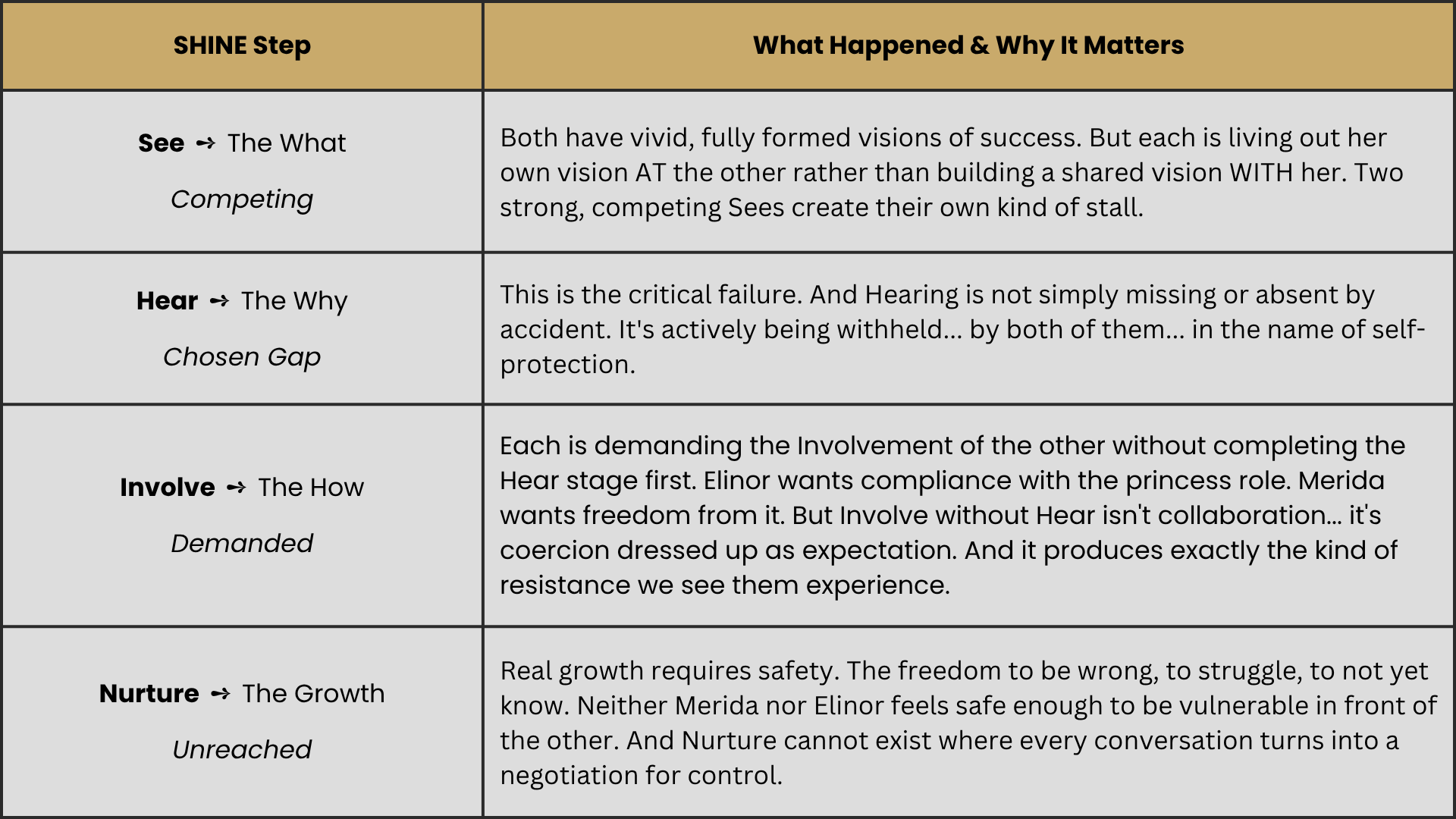
TABLE 1 - WHERE ELINOR AND MERIDA WERE (AND WEREN'T) IN THE SHINE CYCLE™
An Especially Attractive Mahogany Cheeseboard
When Merida is led by the wisps to the witch in the woods and asks for a spell to "change her mum," she isn't asking to be heard or understood by her mother. She's asking for a shortcut past the uncomfortable conversation she doesn't want or know how to have.
In SHINE terms, this is the most extreme expression of bypassing Hear: deciding that the other person's Why is irrelevant, and that the best solution is to simply "make them different". To remove their reasoning, their values, their deeply held sense of purpose... and replace it with something more... convenient.
I think all of us who've ever been in leadership have been tempted by a version of this. Not a literal spell obviously, but the impulse to work around someone instead of with them. To restructure the team so that difficult conversation becomes unnecessary. To find a way to get what we want without having to earn understanding or buy-in first.
But that never works the way we want it to. Just like how the spell doesn't actually change Elinor's mind on the marriage like Merida was hoping for. The spell changes her into an actual bear. The very representation of what their kingdom fears most.
It also offers one of the most quietly devastating metaphors... when you strip someone of their voice, when you decide their Why doesn't matter, you don't actually get a more cooperative person. You get someone that can no longer communicate. Someone who can only react to what's in front of them.
And, if left in that state long enough, someone who will forget who they are... and have to leave to survive.
No Weapons On The Table
Merida and Elinor have to escape the castle and go into the wilderness in order to try and find the witch again. And outside of the castle, the roles, the protocols... the architecture of authority that has, up until this point, defined every interaction between the two of them... something begins to happen.
Because sometimes people cannot Hear each other if the system they're inside was never designed for mutual understanding... only compliance.
The castle gave Elinor authority as Queen, but it also trapped her inside that role. The wilderness removed those structures and outside of them they start to actually Hear each other.
Which is completely ironic considering Elinor is a bear and literally can't talk. But needing to rely on her "wild" daughter's expertise to survive forces Elinor into something she has resisted the entire film: listening without controlling. And through that, she comes to understand Merida's Why in a way she was never open to before.
And Merida's experience in the ruined throne room, of putting together the legend of the Ancient Kingdom and the ramblings of the Witch's last spell, and learning that Mor'du was once a man... all helped Merida understand where her mother was coming from in a way Elinor couldn't have explained.
Sometimes the most important Hear moments happen without a single word being spoken. In a way, it wasn't their ears that most needed opening... it was their hearts.
Mend The Bond
I feel like more than one bond gets mended once Merida and Elinor return to the castle.
There's the bond between the fighting clans in her father's throne room. Merida stands before the entire world her mother has been preparing her for and speaks. Not in defiance or anger. In honesty. She names what she's been wrong about and acknowledges that her choices had costs she didn't stop to consider. And that their alliance is powerful.
"I've been selfish. I tore a great rift in our kingdom. There's no one to blame but me. And I know now that I need to amend my mistake and mend our bond."
There's the bond between mother and daughter as Elinor... still a bear, and still voiceless... guides Merida with pantomimed gestures and the kind of trust she has never really extended to Merida before... to announce they are breaking tradition.
"That we be free to write our own story. Follow our hearts."
And that is Hear completing. Finally, and in both directions at once.
A queen who spent the entire film controlling the narrative lets her daughter speak for her. A daughter who spent the entire film fighting the narrative chooses, freely, to honor the parts of it worth keeping.
Neither of them had to become the other. They just had to finally understand Why the other was who she was. Blending freedom WITH tradition. Authority WITH empathy.
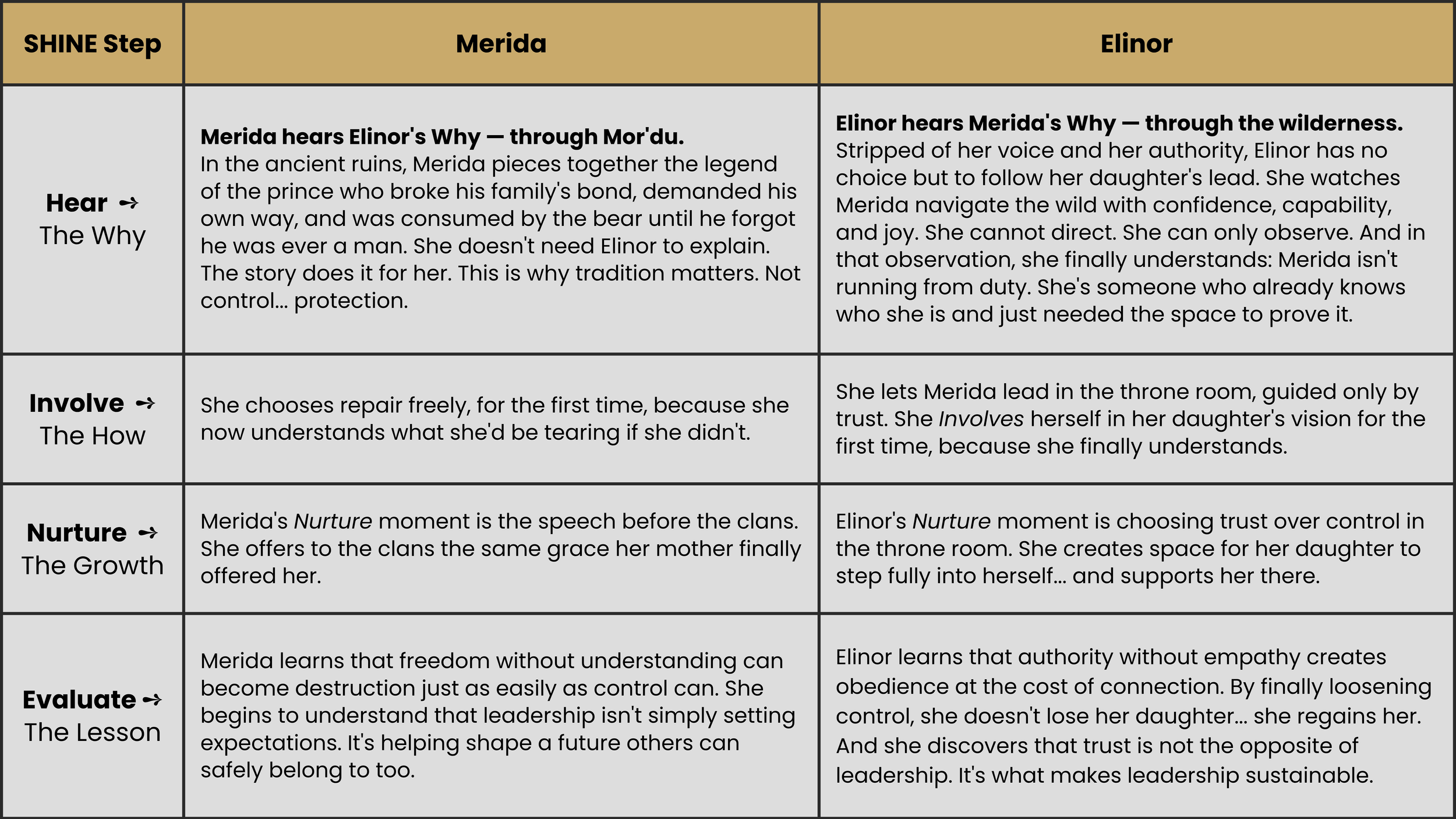
TABLE 2 - HEARING WITHOUT WORDS
What To Take Into Your Week
I want to come back to that dressing room scene one more time. Because I think it's one of the most important moments in the film.
Elinor felt the opening. She started toward it. And then she made a choice... conscious or unconscious... to step back from it. To preserve her role instead of her relationship. To remind Merida to smile instead of whatever truth was forming on her lips.
I understand that choice. I've made versions of it. And I suspect most leaders have.
There's a particular fear that I've seen in the space between authority and empathy. The fear that if you soften, you'll lose the ground you need to stand on. That if you let someone see your uncertainty, they'll stop trusting your direction. That listening somehow signals weakness rather than wisdom.
But here's what I've come to know, and what I think Brave makes undeniable: choosing authority over empathy doesn't protect your leadership. It just pushes the cost of alignment downstream... where it starts to collect emotional interest.
The teams (and families) with the most friction aren't usually the ones where nobody cares. They're the ones where everyone cares enormously but nobody has named The Why underneath the caring.
That's where 𝗧𝗵𝗲 𝗦𝗛𝗜𝗡𝗘 𝗖𝘆𝗰𝗹𝗲™ lives. Not in the dramatic moments of resolution, but in the quiet ones that come just before everything breaks. The moments where a leader feels the opening, and has to decide whether or not to walk through it.
Elinor had to transform into a bear to transform her leadership.
You don't have to.
💬 Comment below: Have you ever felt the moment where empathy started to open a door... and then pulled yourself back into “leadership mode” instead? What were you afraid would happen if you stayed in the conversation?
Thank you so much for joining me for Chapter 2, keep an eye out for the poll to help decide the next movie, and until then...
Don't forget to SHINE ✨
Curious where your team is in The SHINE Cycle™?
I do for real teams what I do with these stories... find the moment that explains everything. Book a 90-min Diagnostic. ✨
New here? The SHINE Cycle™ is a framework for understanding how people and teams move from confusion to competence and what leaders can do to guide that journey with intention. Download the FREE Workbook to learn more.