Chapter 3, Part 1: Life Finds a Way… 🦖
What Jurassic Park teaches about the difference between mimicking a leadership cycle and actually running one.
Welcome to The SHINE Chronicles ✨
A weekly newsletter where I break down stories you already know and love through the lens of The SHINE Cycle™ (See, Hear, Involve, Nurture, Evaluate), my framework for understanding how people and teams develop, stall, and finally move.
[You can read a full breakdown in the free workbook here.]
Each issue, we pull back the curtain on a familiar story and ask: where is this team and what would it take to get them unstuck?
In this issue, we're going to Isla Nublar.
And I want to properly set the stage: Jurassic Park is not a story about a leader who skipped steps in The SHINE Cycle™. John Hammond didn't even ignore the framework. He mimicked it. Pretty much every single stage. With extraordinary production value and an absolute certainty that his masquerade was the same as the real thing.
But it wasn't.
And there’s a huge distinction between mimicking a leadership cycle and actually running one.
Welcome to Jurassic Park
John Hammond’s vision was genuinely extraordinary. I can give him that, fully and without reservation.
He looked at the impossible and decided it was merely an engineering problem. He assembled the resources, the talent, the island, the infrastructure. Built something that had never existed before and filled it with living proof that it really was possible.
And when the Jeep crests the hill, a brachiosaurus comes into view, and everyone is in awe… Grant, Sattler, Malcolm, the audience… every single time, no matter how many times we've seen it.
That is the power of the See step of The SHINE Cycle™ done at the highest possible level. When the What is made undeniably, viscerally visible, and it creates belief before skepticism has time to form a question. Hammond understands this instinctively. His oft repeated line "spared no expense" isn't just a catchphrase… it's a philosophy for him. Make it so real, so present, and so overwhelming that the vision speaks entirely for itself.
And that’s where the trouble begins.
Because Hammond doesn't just show them in order to try and orient towards a shared goal. He is using it to try and close the whole conversation. Seeing the Brachiosaurus isn't an invitation into the work. It's an announcement that the work is nearly complete. For Hammond, this isn't the beginning of the cycle, it’s almost the end of it.
He wants his experts to arrive, look around in amazement, and confirm what he already thinks: Jurassic Park works. And he’s doing this because he seems to have confused two very different questions: "isn't this extraordinary?" and "is this actually working?". To him, the experts are there for validation so he can move forward with opening the park, not an honest reflection loop to improve things.
And I think this is more common than we like to admit.
I Bring Scientists, You Bring A Rock-star
Let’s not forget that Drs. Grant, Sattler, and Malcolm are all on that island because the park's investors demanded expert sign-off before releasing any more funding...
Because someone was already EATEN by a dinosaur.
And they were rightly concerned. Hammond didn't invite scrutiny of his own accord for the betterment of the park. He submitted to it, minimally, because the alternative was losing everything he'd already built. And, as he says so often, he spared no expense…
It’s clear Hammond didn't want an inspection team. He wanted quick endorsements. That’s the posture of a leader who is pretending to Hear rather than genuinely being open to it. And Dr. Ian Malcolm, basically the Hear stage personified, can feel the difference immediately.
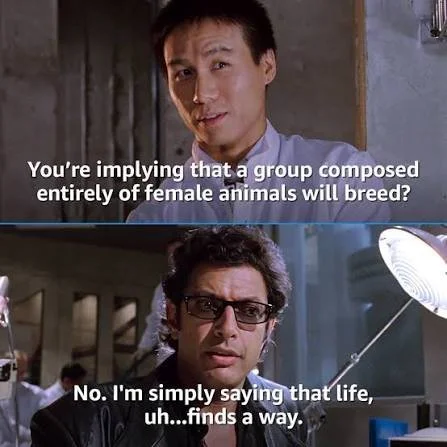
From the moment Malcolm arrives, he starts asking the exact kinds of questions that genuinely engaging in the Hear step is supposed to surface:
➺ What are we assuming?
➺ What happens when the system behaves in ways we didn't model for?
➺ What is the difference between being able to do something and having actually reckoned with whether or not you should?
He isn't trying to obstruct the vision. He's doing what a healthy team desperately needs someone to do.
He’s narrating the reasoning gaps, the intent gaps, and all the other places where the Why hasn't been fully examined yet…. so it can be properly addressed before the next stage: when people get Involved in the How.
“The lack of humility before nature that’s being displayed here… staggers me.” - Dr. Ian Malcolm
Hammond receives Malcolm’s lunchtime ethics speech the way leaders sometimes receive critical voices: with the body language of engagement and the illusion of wanting to hear other viewpoints, but internally they’re just waiting for the other person to finish so they can defend their own stance.
Hammond might appear like he’s listening, that he cares what they have to say… He even talks about saving condors and invites Dr. Grant into the conversation to help defend him, but ultimately he dismisses everyone’s skepticism, laughs off all criticism, and sends them on the tour with his grand-kids anyway.
This is one of the most expensive habits a leader can have. Inviting critical voices and then treating their concerns as entertaining, or optional, rather than as valuable intelligence. It gives the appearance of Hear without any of its actual substance. The questions might get asked. But they don't ever get answered.
When this happens in the workplace, the person asking those questions gradually stops feeling like a contributing member of the team and more like a speed bump. If it goes on for very long, one of a few things usually happens… they try to shrink themselves in order to not cause more delays… Or they just leave.
And hopefully when they do it’s not as dramatic as being chased or eaten by a prehistoric carnivore.
Don’t Get Cheap On Me, Dodgson
Speaking of leaving, we can’t have a SHINE analysis of Jurassic Park without discussing Dennis Nedry.
When I was a kid watching this movie I remember being confused by Hammond's treatment of Nedry. I could tell I was missing something, but it seemed obvious to me that of course he's going to be mean to you if you're mean to him first. As an adult, I have a lot more context for what was actually going on between them — and I'm pretty much of the same opinion.
Here's what the film doesn't spell out but having book context does: Nedry deliberately underbid the project. He low-balled the contract assuming Hammond would likely choose the cheapest option, built the entire foundation of Jurassic Park's systems, and then—when the scope expanded to the scale only Hammond could have dreamed up—wanted to renegotiate. Hammond refused. His position, made clear in their argument, was essentially: you quoted the price, you deliver the work. The fact that the park had become something neither of them could have fully anticipated when the contract got signed was, in Hammond's view, Nedry's problem to absorb.
"I don't blame people for their mistakes, but I do ask that they pay for them." - John Hammond
That line tells you everything you need to know about Hammond's leadership posture toward the people underneath him. Not curiosity about what went wrong. Not accountability for his own role in the scope creep. Just the clean transfer of consequence onto someone else, and a total unwillingness to Hear a legitimate grievance because doing so would have required him to acknowledge that he contributed to it.
So Nedry festered. His workstation was a disaster. His attitude was worse. He was the single point of human failure in a system of extraordinary complexity. Indispensable enough to be dangerous and unseen enough to be resentful. And Hammond, who spared no expense on everything else, chose not to spend the one currency that might have mattered: genuine attention to the person holding the keys.
And that's a failure that runs all the way back through the cycle.
Hammond likely never showed Nedry what the full vision would become, or if he did, never acknowledged what that growth could cost the people building it. He refused to discuss a financial grievance that had real merit.
Hammond expected maximum technical Involvement with zero human investment.
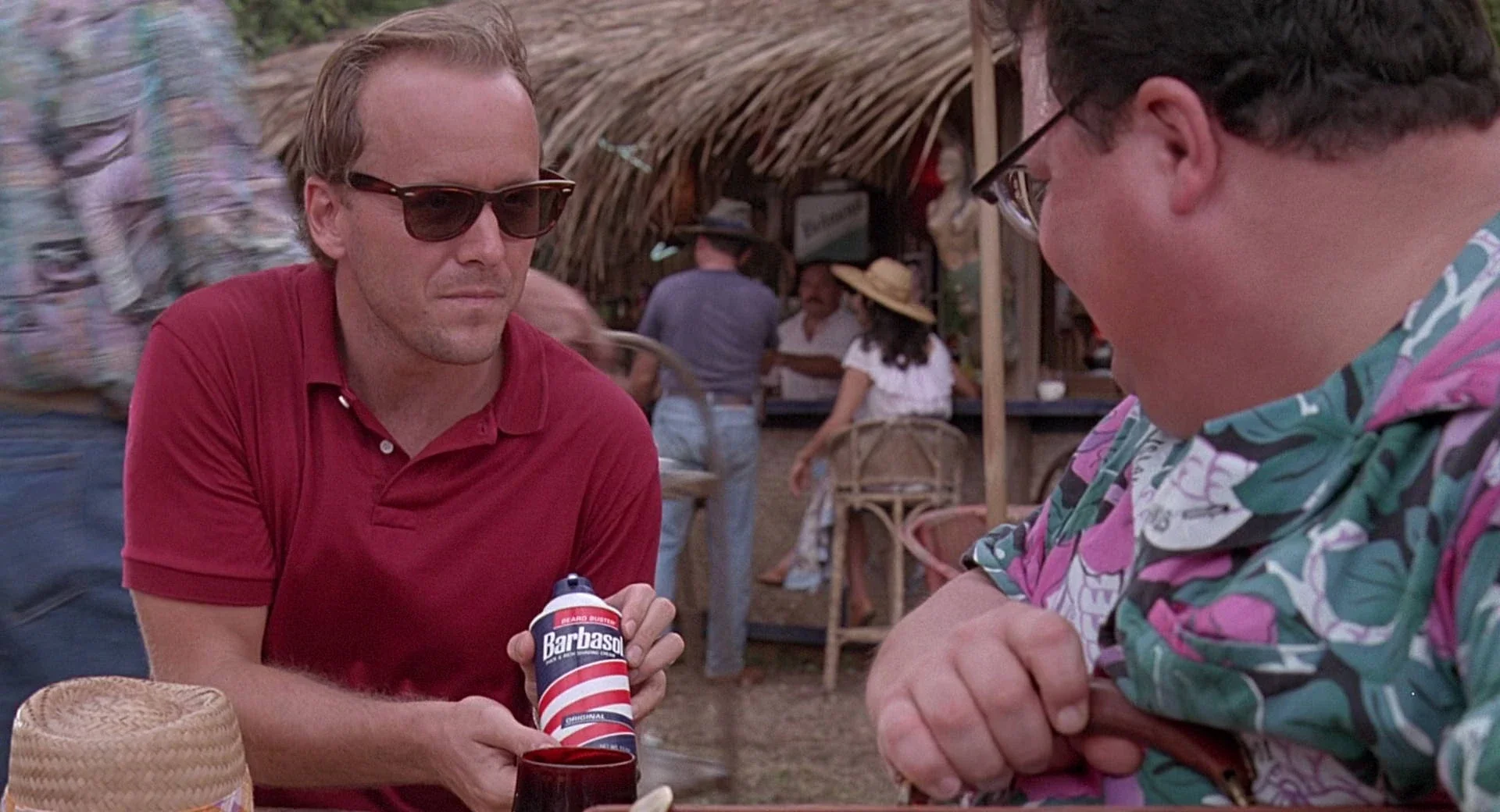
So when a competitor shows up with a briefcase full of money and a fake Barbasol can — Nedry doesn't hesitate. Because Hammond had created a loyalty vacuum so devastating that almost anything would have filled it. The embryos in the shaving cream can aren't really a betrayal... they're kinda the invoice for everything Hammond refused to pay.
Real Involve in SHINE means guiding people into the How by assigning genuine ownership, creating participation that actually shapes outcomes, and treating the people running your systems as collaborators rather than just contractors. Curated participation that can't alter anything isn't Involvement. It's attendance. And attendance, as Nedry demonstrated, doesn't build the kind of loyalty that holds when someone makes a better offer. Sure, he was pretty much a garbage human, and his dumpsite of a workstation reflected that, but allowing him to continue festering in his resentment while still allowing him the technological clearance he had… that really WAS a huge mistake on Hammond’s part.
The fences didn't go down because the technology failed. They went down because the human underneath the technology had been in a personal Storming stage for a very long time… and the environment Hammond built had no mechanism for that to surface, be heard, or be resolved before it became catastrophic.
This is what happens when you spare no expense on the vision and every expense on the people.
In The End, Not Devoid Of Merit
Here is the part of Hammond's story that breaks my heart a little, and is probably the most painful mirror you can hold up to a leader.
He’s sitting at a banquet table in the main cafeteria, framed by all the carefully curated displays of Jurassic Park branded merchandise—all staged and ready to fly off the shelves at the intended grand opening that will never happen now—with multiple tubs of expensive ice cream melting around him. And he’s eating them, because they’d be wasted otherwise. After Ellie comes in to let him know Ian will be okay, John consoles himself with wishful thinking about his grandchildren’s safety.
“They’ll be fine. Who better to get the children through Jurassic Park than a dinosaur expert.” - John Hammond
Followed closely by a recollection of his first attraction, a flea circus called Petticoat Lane, that was so successful he had people saying they could actually see the fleas and coming back again and again. He had manufactured the experience of wonder so completely that the absence of the actual thing didn't matter anymore. People believed the fleas were real.
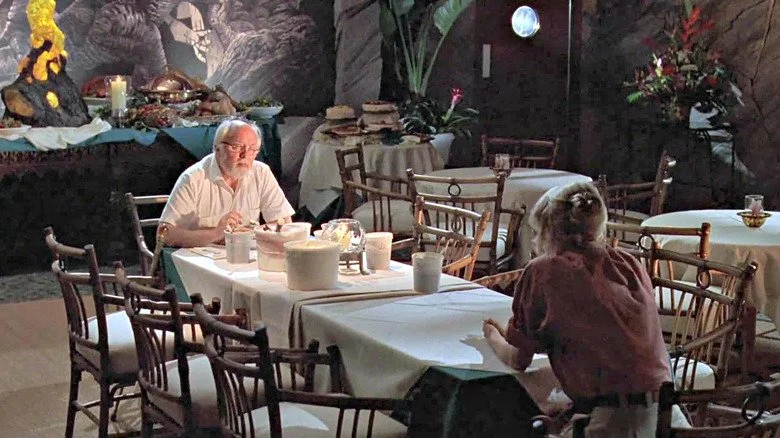
And then… with the park in crisis around him, people dead, his grand-children missing, and a man he's responsible for lying sedated down the hall… he tells her that Jurassic Park was supposed to be different. Real, this time. Something that would give people genuine awe instead of an illusion.
He blames the failure on adding Nedry and the park’s over-reliance on automation. He’s adamant that next time will be better… when they have control again.
But Ellie has seen, up front and charged with adrenaline, the truth:
“You never had control. That’s the illusion. I was overwhelmed by the power of this place. But I made a mistake too. I didn't have enough respect for that power and it's out now. The only thing that matters now are the people we love.” - Dr. Ellie Sattler
Some times there shouldn't be a next time. Some cycles are meant to close. That's the lesson Ellie is handing him in this scene. Evaluate isn't supposed to produce a rehashed version of the same plan. It's supposed to produce genuine learning. The kind of learning that changes something foundational about how the next cycle begins.
Even if that means not starting one at all.
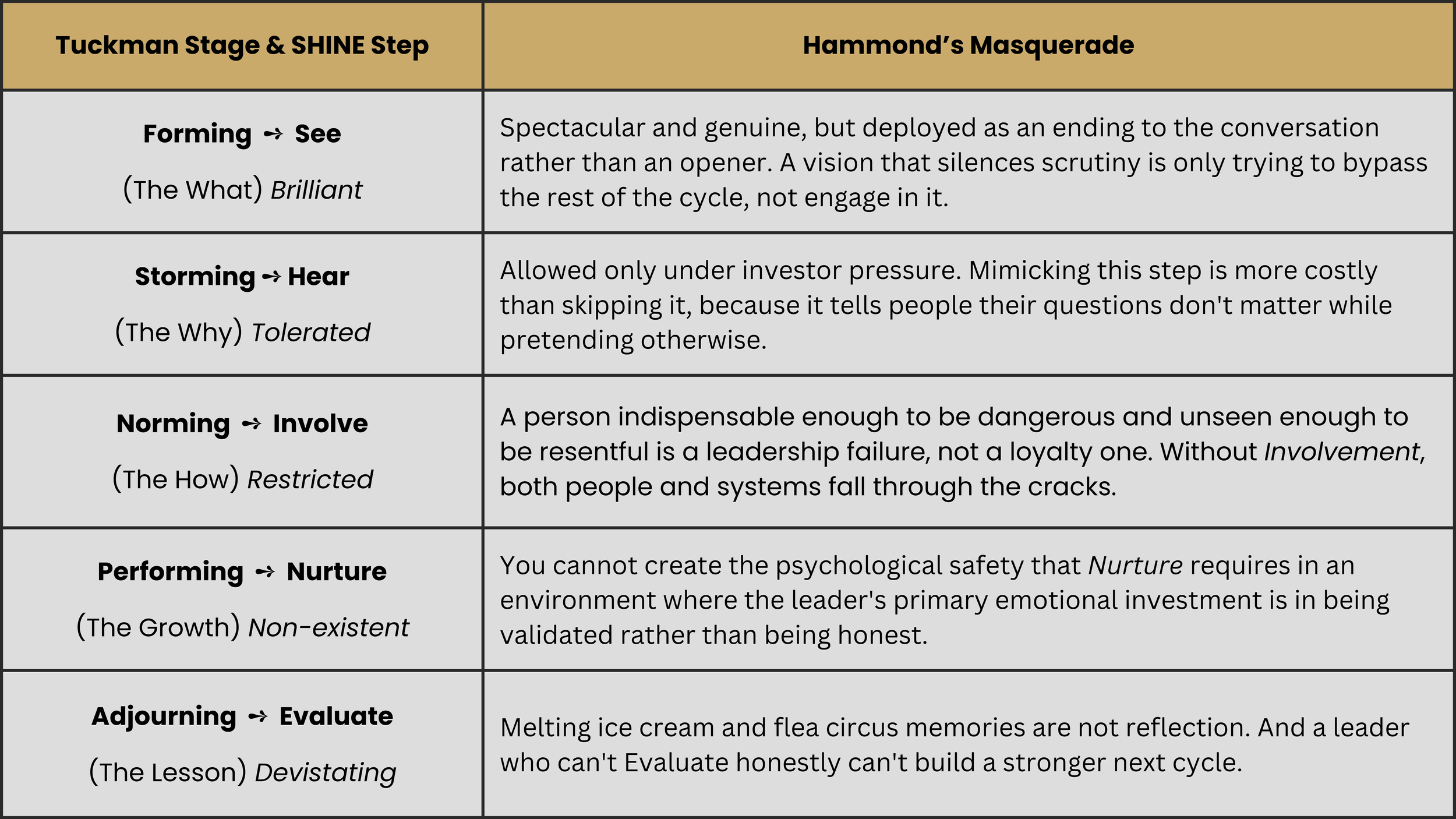
TABLE 1 - HAMMOND’S MASQUERADE
✨ What To Take Into Your Week
Hammond wasn't a villain. That's the most important and the most uncomfortable thing about him. He was a man of genuine wonder, real vision, and extraordinary commitment to something he believed in with his whole heart. He spared no expense because he cared: about the park, about the dream, about the moment someone would stand in front of a living dinosaur and feel what he felt.
But the dinosaurs still ate people.
Caring deeply about your vision isn't the same as caring about the people you need to bring it to life. Because mimicking the stages of leadership — going through the motions of See, tolerating Hear, staging Involve — produces the appearance of a functioning cycle while generating none of its actual effects. The team doesn't align. The buy-in doesn't hold. Eventually, the human beings underneath the systems start finding their own ways to be seen, on their own terms, with whatever leverage they have available.
The question this film leaves me with (and every leader willing to sit with it) is this:
Which parts of your leadership cycle are you genuinely running, and which parts are you mimicking?
➺ Where are you truly showing people what you are asking them to build, listening to what they see from their position, and giving them meaningful ownership?
➺ Where are you mimicking the correct motions in a way that looks like leadership from the outside but does not allow anyone else’s perspective to change what happens next?
➺ And who is the Malcolm in the room… the person asking questions you have been receiving as charming, dramatic, or inconvenient rather than urgent… the one you have only been pretending to Hear?
Hammond had every resource in the world. He had the vision, the funding, the talent, and the island. What he lacked was the genuine willingness to let the cycle change anything. He would See only what supported the dream, Hear only what did not threaten it, and Involve others only while he retained control of the outcome.
That may be the clearest distinction between running The SHINE Cycle™ and faking it: a real cycle leaves room for what you learn along the way to alter the plan… and perhaps even alter you.
Which brings us to one final SHINE Cycle unfolding beneath everything we have explored so far.
While Hammond is trying to prove that his vision does not need to change, another man is discovering that one of his most firmly held conclusions might be wrong. His cycle is not about managing a park, leading a team, or surviving the dinosaurs running through it.
It is personal.
Dr. Alan Grant arrives on the island certain that he does not like children. He leaves it with Tim and Lex asleep against him, trusting him completely.
How he gets there—and what a theory called Transformative Learning can teach us about the journey—is where we will pick up in Chapter 3, Part II: “I Guess We’ll Just Have to Evolve Too.”
💬 Comment below: Which stages of your leadership cycle are you genuinely running — and which ones might just be part of a masquerade?
Thank you so much for joining me for Chapter 3, Part I. Keep an eye out for Part II, and until then, remember:
Life finds a way. Make sure your team does too.
Curious where your team is in The SHINE Cycle™?
I do for real teams what I do with these stories... find the moment that explains everything. Book a 90-min Diagnostic. ✨
New here? The SHINE Cycle™ is a framework for understanding how people and teams move from confusion to competence and what leaders can do to guide that journey with intention. Download the FREE Workbook to learn more.